
Split system vs ducted air conditioning: which is right for your home
By Clara Abbott · Updated 2026-07-15
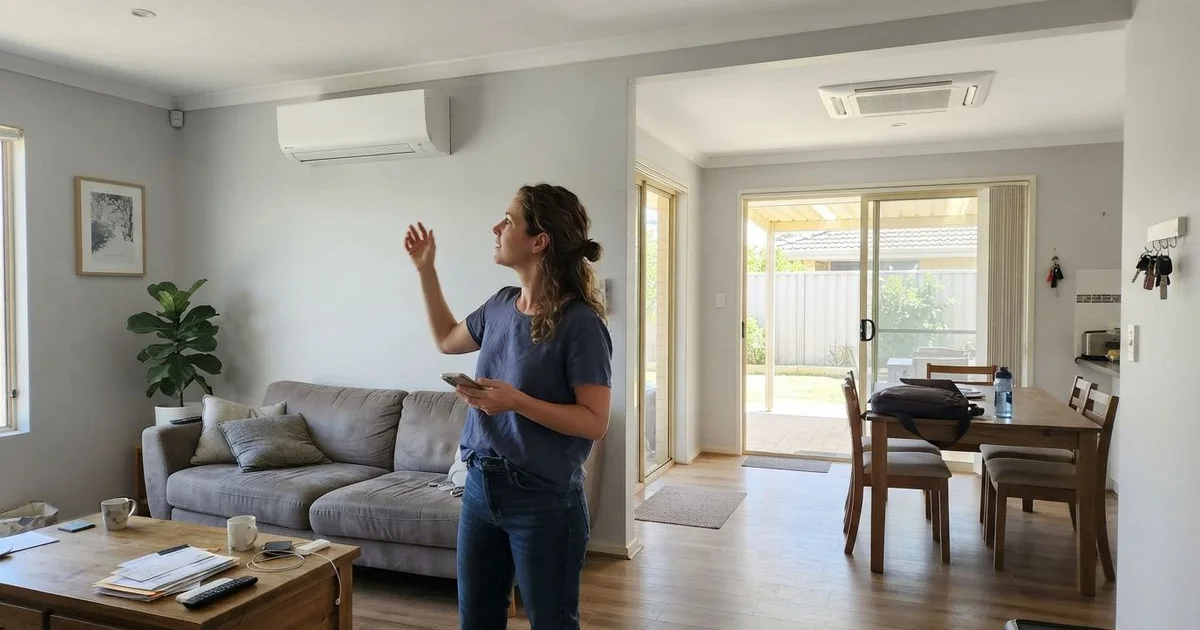
This is one of the first decisions most Perth homeowners face when they start looking into air conditioning, and it shapes everything downstream: budget, installation complexity, and how the system fits your daily routine. Neither option is universally better, it comes down to your home’s layout, how many rooms need conditioning, and what you’re trying to solve.
The core difference
A split system conditions one room or zone through a wall-mounted indoor head connected to an outdoor compressor. It’s a contained, room-by-room solution: install one where you need it, and leave other rooms unconditioned if you don’t. A ducted system conditions multiple rooms through a single outdoor unit and a network of ceiling ductwork, with vents in each room and zoning to control which areas run at any given time. It’s a whole-of-home approach installed once, rather than built up room by room.
How they compare
| Factor | Split system | Ducted system |
|---|---|---|
| Upfront cost | Lower per room, scales with each unit added | Higher upfront, but covers the whole home in one job |
| Noise indoors | Indoor head audible in the room | Quieter, air delivered through ceiling vents |
| Visual impact | Wall-mounted unit visible in each room | No visible indoor unit, only ceiling vents |
| Flexibility | Add rooms one at a time as budget allows | Zoning covers the whole layout from install day |
| Retrofit difficulty | Straightforward, one wall penetration per unit | Depends on roof cavity access and ceiling space |
| Running cost | Efficient if you only condition rooms in use | Efficient with good zoning, less so running the whole system for one room |
When a split system makes more sense
A split system tends to be the better fit if you’re conditioning one or two rooms rather than a whole house, working with a tighter budget and want to add rooms over time, or living somewhere with limited roof cavity space that would make ductwork difficult or expensive. It’s also the simpler retrofit option, since it needs far less structural work than opening up a ceiling to run ducting through an established home.

When ducted air conditioning makes more sense
Ducted systems suit homes where most or all rooms need conditioning, where a clean, unobtrusive look matters (no wall units to work around), or where you’re building new or doing a major renovation and can plan the ductwork in from the start. Because the compressor sits outside and the delivery is through ceiling vents, ducted systems also tend to feel quieter day to day, which matters if you’re sensitive to background noise or have a home office.
A practical way to decide
Start by counting how many rooms genuinely need conditioning, not how many you’d like conditioned in an ideal world. If it’s one or two, split systems are usually the more cost-effective path, and you can always add another unit later. If it’s most of the house, or you’re planning ahead for a renovation, ducted starts to make more financial sense, since installing once tends to cost less overall than fitting five separate split systems room by room.
Roof access is the other practical filter. If your home has a low or awkward roof cavity, get a contractor to check feasibility before you commit to a ducted quote, since some older Perth homes genuinely aren’t well suited to it without significant extra work. Whichever system you land on, choosing the right installer matters as much as the system itself; see our guide on how to choose an air conditioning contractor in Perth for what separates a good one from an average one.
Bringing your household into the decision
If your household is growing, or you expect to renovate or extend in the next few years, think about which option scales better with those plans. A ducted system with an outdoor unit sized for future zones can be easier to expand into than adding split system after split system, each with its own outdoor unit taking up space around the property.
For more on how we assess and rank contractors across both system types, read our methodology page. You can also browse the home page for guides covering cost, installation and upkeep for whichever option you land on.
FAQ
- Can I mix split systems and ducted air conditioning in the same home?
- Yes, though it's not common. Some homes run ducted in the main living zones and a separate split system in a room that's harder to reach with ductwork, like a granny flat or a later extension. It adds complexity, so most owners pick one approach for consistency.
- Which option is quieter?
- Ducted systems are generally quieter indoors, since the compressor and fan sit outside and air is delivered through ceiling vents rather than a wall-mounted unit in the room. Split systems have come a long way on noise, but the indoor head is still audible in a quiet room.
- Which is easier to retrofit into an existing home?
- Split systems, in most cases. A single split system needs one wall penetration and a short pipe run, while ducted systems need enough roof cavity space to run ductwork through the whole house, which isn't always straightforward in older Perth homes.
- Do I have to condition every room with a ducted system?
- No. Zoning lets you turn individual rooms or areas on and off independently, so you're not cooling or heating empty rooms. More zones add cost, but they also add flexibility over a single-zone ducted setup.